All prices on this page are quoted in USD unless otherwise noted.
The Bali villa rental market has matured significantly. The average guest arriving in Bali today has stayed in three or four Bali villas before. They know what good looks like. A basic plunge pool and tile floors no longer command the nightly rate they did in 2019.
Investors building in 2026 should be designing for a more discerning guest. Not a more expensive one - the demographics are broad - but one who has specific expectations about what a premium Bali villa looks and feels like, and who will book elsewhere if your property does not meet them.
These are the design elements we see driving occupancy, premium nightly rates, and buyer interest in the current market. You can see how they play out across our villa designs across Bali.
The outdoor living area is now the hero
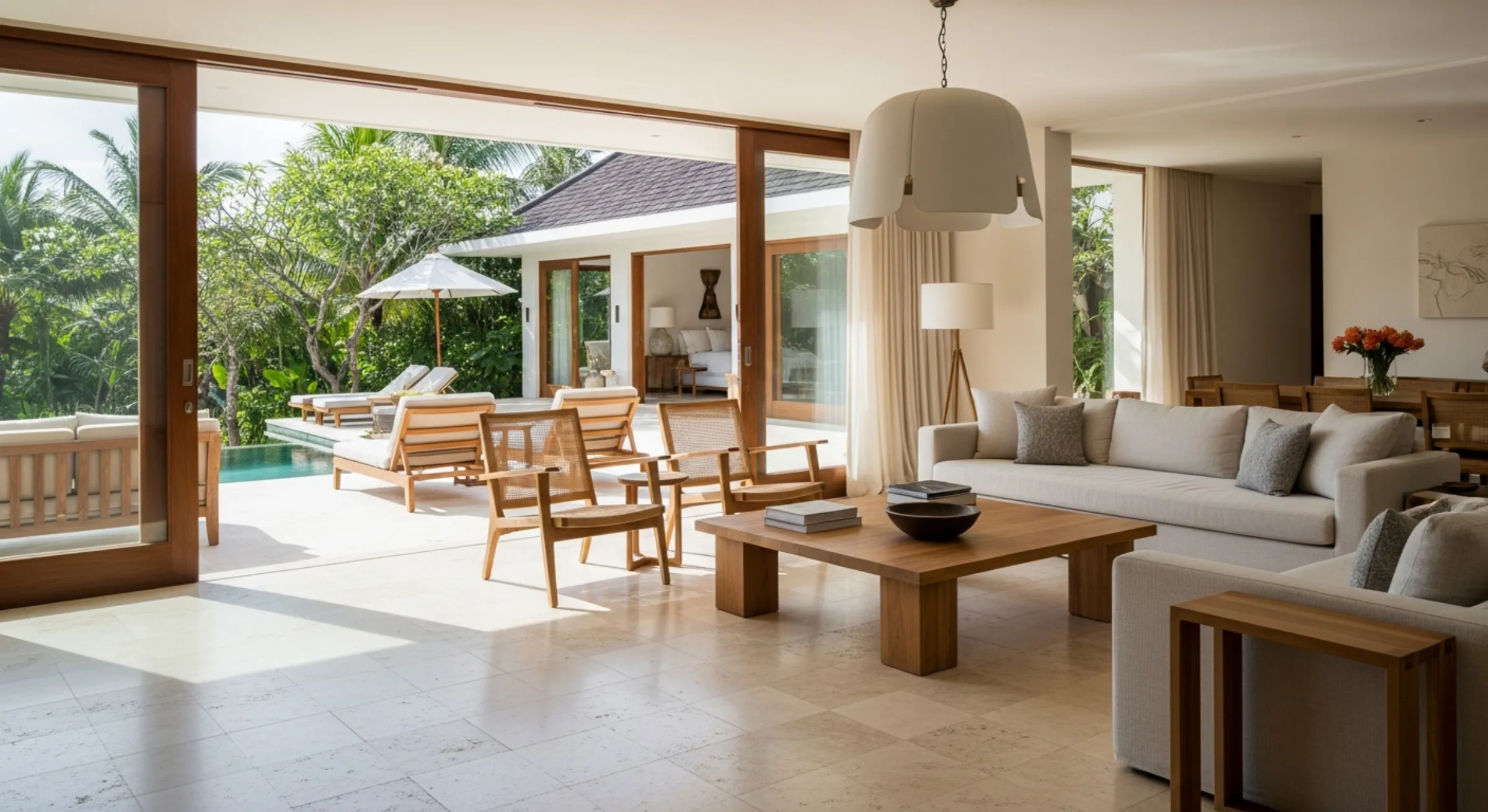
Five years ago, the pool was the booking photograph. Today, it is the outdoor living space around the pool. Guests are not just looking for a pool - they want an outdoor room: a daybed or a hanging chair positioned to face the view, a dining table that seats eight for the group dinner, outdoor lighting that looks as good at 9pm as it does at noon.
Villas with a compelling outdoor living configuration consistently photograph better than identical layouts with a basic sun deck. On booking platforms, the photograph is the booking. A great outdoor room adds meaningful occupancy, not just aesthetic quality.
The wellness corner
Cold plunge pools and outdoor showers now appear in a significant portion of new rental villa builds. The psychology is straightforward: these are the elements guests post about. They photograph extremely well. They are associated with a premium experience. And they cost relatively little compared to the booking premiums they generate.
A cold plunge at a good build cost of $4,000-8,000 can add $20-30 to average nightly rates for a 2-bedroom villa. At 70% occupancy over 25 years, the return on that investment is significant. Not every villa needs one - but if you are building in Uluwatu or Canggu and competing in the $200+ per night market, the absence of a wellness element is now more noticeable than its presence.
Natural materials over tile
Polished concrete, brushed timber, local stone, and lime plaster are replacing porcelain tile as the default finish in premium Bali villa builds. The shift is partly aesthetic and partly practical - these materials age better in the tropical climate, require less maintenance, and photograph differently depending on the light.
Palimanan stone (a warm Javanese limestone) is widely used in Bali for floor and wall cladding and suits the visual aesthetic guests are looking for. Terrazzo is back - not as a retro reference but as a genuinely durable finish that works in wet zones. Cheap imported porcelain tile is the aesthetic signal that a build was value-engineered.
The kitchen is now on display
Guests who book a villa for a week want to cook sometimes. An open kitchen that is visible from the living area and outdoor terrace - where someone can make coffee while others sit outside - has become standard in well-designed rental properties. A concealed kitchen behind a wall was the preferred design 10 years ago. Now it reads as dated.
The kitchen also photographs. A marble or stone counter, good appliances, and a pendant light above the island appear in booking images and reinforce the premium positioning. The investment in a good kitchen fit-out returns in both occupancy and nightly rate.
Indoor-outdoor flow
The boundary between inside and outside in a Bali villa should dissolve when the doors are open. Folding or sliding glass walls, retractable screens, and covered terraces that are genuinely usable during rain are all features that guests notice. A villa where you have to go through a sliding door to get to the pool feels different from one where the living space opens entirely to the terrace.
This is more of a design decision than a construction cost - it is about how you configure the plan, not how much you spend per sqm. Architects who build frequently in Bali understand this instinctively. Architects who do not have specific tropical residential experience sometimes miss it.
What is over-indexed (and what to avoid)
Not every trend is worth following. A few things that have been over-applied in Bali villa design:
- -Excessive Balinese decorative elements - carved wooden panels and stone statues as decoration rather than architecture. It reads as costume for international guests
- -Shaker kitchen doors and farmhouse sinks - a style that has saturated Australian and European renovation content and now reads as generic
- -Very dark interiors - dark stone and dark wood look dramatic in renders, but reduce natural light in a tropical climate where light is the point
- -Smart home technology without strong wifi - smart locks and automated blinds are undermined by unreliable connectivity
- -Oversized master bedrooms at the expense of outdoor space - guests come to be outside, not to watch TV in a large bedroom
Design for the photograph first
In the short-term rental market, bookings are driven by photographs. The photograph comes before the description, before the location, and often before the price. A villa that photographs at $300 per night and is priced at $250 will outperform a villa that photographs at $200 per night and is priced at $250.
When we design a villa for rental, we think about which five photographs will appear on the booking platform listing and work backwards from there. The hero shot (usually pool + outdoor living area), the bedroom with natural light, the bathroom, the kitchen or dining space, and the view. If any of those five cannot be photographed compellingly, it is a design problem, not a photography problem.