All prices on this page are quoted in USD unless otherwise noted.
Cemagi was Bali's quiet coastal secret five years ago. Land was $15K per 100m², surf was uncrowded, and most people in Canggu had never heard of it. Today Cemagi is $38K-55K per 100m² and the developers have arrived. Seseh and Kedungu are at a similar price band but still earlier in their development cycle - the discount is in the build-out, not the headline number.
That comparison is seductive. It is also worth examining carefully, because the two situations are not identical. Here is what you should know before making any decisions.
Area at a glance
$30K-55K per 100m²
Land price range
25-35 min
From Canggu
Tabanan
Regency
Black sand, surf breaks
Coastline
Where these areas are
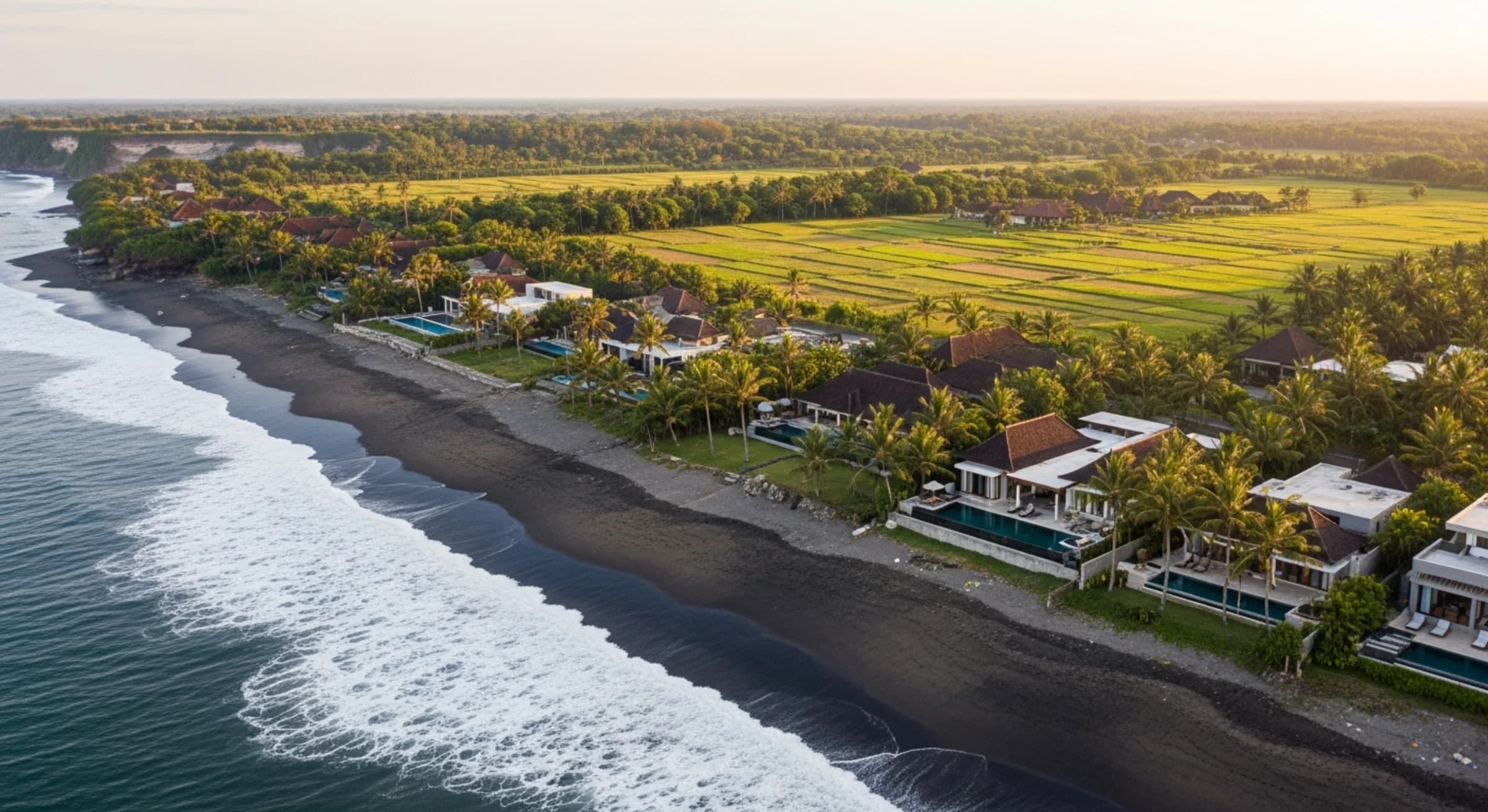
Seseh and Kedungu sit on the coast of Tabanan regency, roughly 5-10 km north of Cemagi along the Jalan Pura Batu Bolong coastal road. Kedungu is the southern end, Seseh is slightly further north. Both are farming villages with black sand beaches typical of Tabanan's volcanic coastline.
Kedungu has a consistent right-hand reef break that the surf crowd has been talking about for a few years now. Seseh is quieter, more agricultural, with a small temple beach. Neither has the infrastructure of Cemagi yet - no restaurant strip, patchy road quality once you get off the main route, and limited villas in operation.
That changes when you understand where Bali's development pressure comes from. The south Bali tourist belt runs from Seminyak down to Canggu, then Pererenan and Cemagi. The only direction left is north along the coast. Seseh and Kedungu are the next stretch of coastline in that line.
How these areas compare to their neighbours
| Area | Land price | Infrastructure | Stage |
|---|---|---|---|
| Canggu central | $70K-95K per 100m² | Fully built out | Mature |
| Pererenan | $55K-75K per 100m² | Strong | Active |
| Cemagi | $38K-55K per 100m² | Developing | Early-mid |
| Seseh | $38K-55K per 100m² | Limited | Early |
| Kedungu | $30K-45K per 100m² | Minimal | Frontier |
The real risks
Seseh and Kedungu are in Tabanan regency, not Badung (where Canggu, Seminyak, and Uluwatu sit). This matters. Tabanan has different zoning administration, different permit processes, and historically slower development approval timelines than Badung. Some parcels that look attractive on price have zoning issues that make commercial villa development complicated.
Zoning uncertainty
A significant portion of land in this area is classified as agricultural (sawah). Converting to commercial tourist use requires permits that are not always straightforward. Always verify zoning category before making an offer - specifically check for Persawahan (rice field) designation.
Infrastructure timeline
There is no guarantee roads, electricity stability, and water supply will improve on any given schedule. In Cemagi, it took 3-4 years from the first wave of development for infrastructure to genuinely catch up. Seseh and Kedungu may follow a similar or longer timeline.
Rental market immaturity
With limited supply of villas currently operating, it is hard to benchmark realistic occupancy. A well-designed villa can attract the right guests, but you are building a market, not entering one. Budget for a slower ramp-up in years one and two.
Resale liquidity
Selling an early-stage area property is harder than selling in an established market. Your buyer pool is narrower. If you need liquidity within 3-4 years, this is not the right investment.
What makes the case for early entry
The price gap is real. A beach-view parcel in Kedungu at around $37.5K per 100m² sits at roughly half the price of equivalent central Canggu land. That gap does not persist indefinitely once development activity reaches critical mass. The question is whether you have the holding capacity and risk tolerance to capture it.
Kedungu's surf break is already attracting a niche but loyal market - the kind of guests who will pay well for a well-designed villa on a break that still has empty lineups. That market tends to build word-of-mouth fast and sustains good occupancy even before area infrastructure matures. We have seen this pattern in Uluwatu, and in the early Cemagi days.
If you are building with a 7-10 year horizon, the risk profile here is actually not that different from Cemagi in 2021. If you need a fully functioning rental market from day one, go somewhere else.
Who Seseh and Kedungu suit
- -Investors with a 7-10 year hold period who can absorb a slower rental ramp-up in years 1-3
- -Buyers who want coastal Bali at a price point that Canggu, Pererenan, and Cemagi no longer offer
- -Surf market operators - Kedungu has a specific appeal to the surf-travel segment that works even in an underdeveloped area
- -Buyers who are comfortable doing thorough zoning and title due diligence before committing
- -Investors who already own in a mature area and want to add an early-stage position to their portfolio